

Cupronickel Tube
Select the alloy for seawater velocity and corrosion exposure
A Cupronickel Tube is commonly specified for marine seawater cooling lines, fire-fighting systems, condensers, heat exchangers, desalination plants, and offshore utility piping. The primary purchasing concern is not nominal copper content. It is whether the selected alloy, wall thickness, fabrication route, and inspection scope will resist localized corrosion, erosion-corrosion, and galvanic interaction throughout the intended operating cycle.
The two principal marine grades are copper-nickel 90/10, UNS C70600, and copper-nickel 70/30, UNS C71500. Both form a protective surface film in clean, oxygenated seawater. This film needs normal seawater exposure to develop. Extended stagnant conditions, sulfide-polluted water, debris accumulation, or incorrect commissioning can damage it.
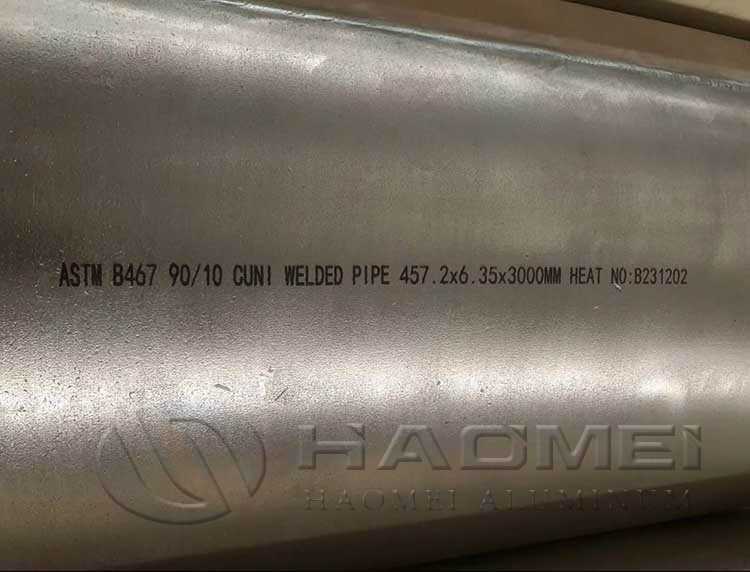
90/10 versus 70/30: specify performance, not only chemistry
| Item | 90/10 Cu-Ni, UNS C70600 | 70/30 Cu-Ni, UNS C71500 | Purchasing implication |
|---|---|---|---|
| Nominal composition | 90% Cu, 10% Ni, with controlled iron and manganese additions | 70% Cu, 30% Ni, with controlled iron and manganese additions | Require the applicable UNS designation on the order and mill certificate. |
| Typical marine use | General seawater piping, condenser tubing, cooling-water systems | Higher-severity seawater service, higher flow conditions, offshore and naval applications | Select 70/30 where the design assessment identifies greater erosion-corrosion demand. |
| Seawater corrosion resistance | Excellent in properly operated seawater systems | Generally higher resistance to impingement and erosion-corrosion | Do not substitute grades solely on price. Review velocity, geometry, and water quality. |
| Relative cost exposure | Lower nickel content | Higher nickel content | Lock the alloy grade before pricing because nickel content materially changes cost. |
| Fabrication | Readily cold formed and welded using suitable procedures | Weldable, but procedure qualification and filler selection need closer control | Request welding documentation when fabricated spools are supplied. |
The Copper Development Association describes 90/10 copper-nickel as the usual choice for general seawater service and identifies 70/30 as providing higher resistance under more demanding flow conditions. Actual velocity limits cannot be set from alloy name alone. They depend on pipe diameter, bends, entrances, suspended solids, temperature, chlorination practice, and whether flow is continuous.
For example, an oversized pump can create local impingement at reducer outlets, tee branches, pump discharges, and partially open valves even when the calculated line velocity is acceptable. Require the piping designer to review these locations separately.
Match the product standard to the application
Use the standard that matches the delivered form. ASTM B111/B111M covers seamless copper-alloy tube for condensers and heat exchangers. ASTM B466/B466M covers seamless copper-nickel pipe and tube. For projects using European specifications, EN 12451 applies to seamless round tubes for heat exchangers.
Do not write only "Cu-Ni 90/10 tube" on a purchase order. Include the following data:
- Alloy designation: UNS C70600 or UNS C71500.
- Product standard and contracted edition, such as ASTM B111/B111M or ASTM B466/B466M.
- Seamless construction requirement.
- Outside diameter, nominal wall thickness, length range, and end finish.
- Temper condition, when relevant to bending or expansion.
- Required testing, certification, marking, packing, and traceability level.
- Service medium: seawater, brackish water, chlorinated seawater, or process fluid.
For a heat exchanger, tube OD, wall thickness, straightness, temper, and tube-end condition affect rolling or welding into the tube sheet. For a marine piping spool, dimensional compatibility with flanges, bends, and Cupro Nickel Fittings should be confirmed before production. Mixing nominal pipe dimensions with heat-exchanger tube dimensions is a frequent cause of site fit-up delays.
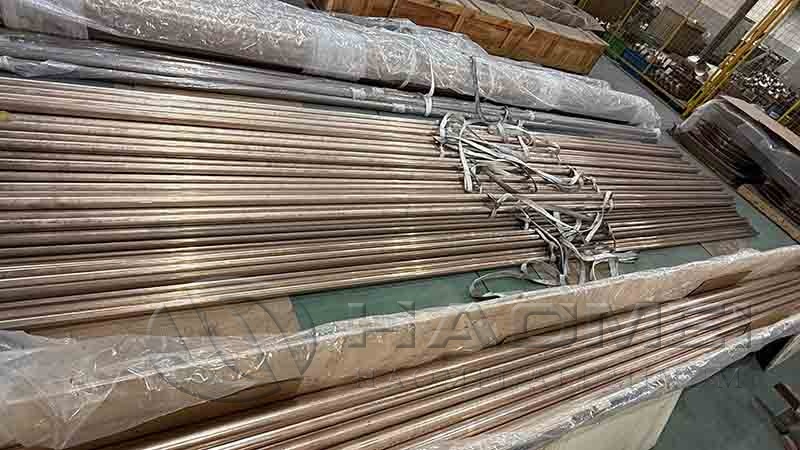
Inspection plan: establish acceptance evidence before manufacture
A mill test report alone does not demonstrate that every supplied length meets dimensional, nondestructive examination, and pressure-test requirements. Create an inspection and test plan, ITP, with hold points for high-volume projects.
| Control point | What to require | Why it matters |
|---|---|---|
| Heat traceability | Heat number on material certificate and durable identification linked to bundles or lengths | Prevents mixing of C70600, C71500, or nonconforming material. |
| Chemical analysis | Certificate values for Cu, Ni, Fe, Mn, and other elements against the named material specification | Iron content is important to seawater film formation in standard Cu-Ni grades. |
| Mechanical properties | Tensile strength, yield strength where specified, and elongation from the applicable product standard | Confirms suitability for forming, expansion, and handling. |
| Dimensions | 100% OD and wall verification plan, plus length and straightness checks | Local thin wall reduces pressure margin and erosion life. |
| Nondestructive testing | Eddy-current examination when required by the applicable specification or contract | Detects discontinuities that visual inspection may miss. |
| Pressure integrity | Hydrostatic or pneumatic test only when specified, with pressure, hold time, medium, and acceptance criteria stated | Avoids unclear test responsibility between mill and fabricator. |
| Surface condition | Internal and external visual inspection for dents, scratches, oxide scale, oil, and embedded contamination | Surface defects can become corrosion initiation points. |
ASTM B111/B111M and ASTM B466/B466M set product-specific requirements, but the project specification must state additional tests that are not automatic for every order. Ask the supplier to identify each test method, sampling frequency, and acceptance criterion in the ITP rather than using the general phrase "tested to ASTM."
Control corrosion risks at installation
Copper-nickel alloys are relatively noble when coupled electrically to carbon steel or marine aluminum in seawater. A poorly designed connection can accelerate corrosion of the less noble metal. Electrical isolation, compatible transition pieces, coating boundaries, and cathodic-protection design should be reviewed as one system.
Use this installation checklist:
- Remove fabrication debris before hydrostatic testing and commissioning. Sand, weld slag, and metal chips can create high-velocity attack points.
- Avoid prolonged stagnant seawater after filling. If lay-up is unavoidable, follow the vessel or plant corrosion-control procedure.
- Confirm that chlorination concentration and exposure time follow the system engineering specification. Over-chlorination can be harmful in some conditions.
- Use qualified welding procedures. AWS A5.7 filler classifications such as ERCuNi and ERNiCu-7 are commonly considered for copper-nickel welding, but filler selection must match the base alloy and approved WPS.
- Prevent carbon-steel grinding dust from contaminating completed pipework. Segregate tools and clean surfaces before service.
Sourcing checklist for contract release
Before releasing production, obtain these documents and controls from each qualified manufacturer:
- A sample material test certificate showing the exact standard, alloy, dimensions, heat number, chemistry, and mechanical results.
- A dimensional tolerance schedule referenced to the ordered product standard.
- The proposed nondestructive examination and pressure-test procedure.
- Packaging details that protect tube ends, prevent bundle abrasion, and keep material dry during sea freight.
- A traceability map connecting each shipment bundle to certificate heat numbers.
- Third-party inspection access at raw-material receipt, final inspection, and loading when contract risk requires it.
- A documented nonconformance process covering segregation, disposition, replacement timing, and certificate correction.
For repeat marine programs, retain incoming-inspection data by heat number and supplier. Comparing wall measurements, eddy-current rejection rates, delivery damage, and installation rejects provides evidence for future supplier allocation decisions.