

Copper Nickel Pipe Fittings
Copper nickel pipe fittings are frequently discussed in recent marine engineering, ship repair, desalination, and offshore piping conversations. The questions below reflect recurring English-language Q&A topics around Cu-Ni materials, especially for seawater service. The answers focus on practical selection factors rather than repeating generic material descriptions.
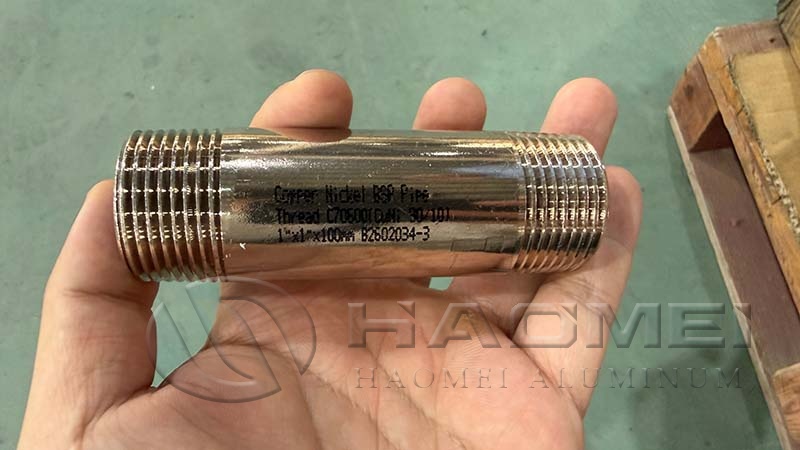
1. Which copper nickel pipe fittings are better for seawater, 90/10 or 70/30?
The right alloy depends less on the word "seawater" alone and more on flow conditions, temperature, biological activity, and the expected service life. Cu-Ni 90/10, typically containing about 90% copper and 10% nickel, is widely used for moderate seawater duties, cooling-water branches, firewater lines, and shipboard utility piping. It offers a strong balance of corrosion resistance, workability, and cost control.
Cu-Ni 70/30 contains more nickel and generally provides higher resistance to fast-moving seawater, erosion-corrosion, and impingement near pumps, elbows, reducers, and valve outlets. It is often preferred where turbulence is unavoidable or where pipe systems operate continuously at demanding flow rates.
| Operating condition | Often suitable choice | Reason |
|---|---|---|
| Moderate-flow seawater line | Cu-Ni 90/10 | Reliable corrosion performance and economical material use |
| Pump discharge or high-velocity bend | Cu-Ni 70/30 | Better erosion-corrosion resistance |
| Marine HVAC cooling circuit | Cu-Ni 90/10 | Common option for stable, clean seawater service |
| Offshore process water line | Cu-Ni 70/30 | Higher durability under severe operating conditions |
Fittings should match the pipe alloy whenever possible. Installing a 70/30 fitting in a 90/10 system is not automatically wrong, but mixed materials should be reviewed for welding procedure compatibility, dimensional requirements, and galvanic interaction with adjacent metals.
2. Do copper nickel pipe fittings corrode in seawater?
Yes, but they corrode in a controlled and normally slow manner when the system is designed and operated properly. Copper nickel alloys develop a thin, protective surface film after exposure to clean, oxygenated seawater. This film is the reason Cu-Ni systems can perform well for decades in many marine applications.
The greatest risk is not uniform corrosion. Localized damage is more likely when there is stagnant seawater, prolonged commissioning downtime, heavy sulfide pollution, abrasive solids, excessive velocity, or poor welding cleanliness. A newly installed Cu-Ni line also needs a reasonable conditioning period. During early service, stable flow helps the protective film form evenly.
For this reason, pipe fitting geometry matters. Sharp internal steps, rough weld roots, poorly aligned reducers, and undersized branches can create turbulence that strips or disrupts the protective layer. Smooth-bore elbows, correctly sized reducers, and controlled weld profiles support longer service life.
When specifying Cupro Nickel Fittings, request confirmation of alloy grade, applicable standard, pressure rating, end connection, and whether the fitting is seamless, welded, forged, or cast. These details affect corrosion behavior as much as the nominal alloy name.
3. Can copper nickel pipe fittings be welded to stainless steel or carbon steel pipe?
They can be connected, but direct welding requires a qualified dissimilar-metal welding procedure. Copper nickel and steel have different thermal expansion, melting behavior, and metallurgical characteristics. A joint that looks acceptable externally may still have dilution, cracking, or corrosion concerns if the filler metal and heat input are unsuitable.
In many marine systems, flanged joints, insulating spool arrangements, or transition pieces are selected instead of direct butt welding. These approaches simplify maintenance and can reduce galvanic corrosion risk, particularly where carbon steel is exposed to conductive seawater.
If welding is necessary, the fabricator should verify the base-metal grades and select filler metal accordingly. Nickel-based consumables are often considered for Cu-Ni-to-steel transitions, but the final choice must follow the approved welding procedure specification. Post-weld cleaning is equally important. Carbon steel particles embedded on the Cu-Ni surface can create staining and localized corrosion initiation points.
A practical specification should identify:
- Pipe and fitting alloy, such as UNS C70600 or UNS C71500.
- Weld-end schedule or wall thickness.
- Filler metal classification and welding process.
- Non-destructive examination requirements.
- Pickling, cleaning, flushing, and commissioning conditions.
4. Are cast copper nickel fittings acceptable for marine piping?
Cast fittings can be suitable, especially for complex valve bodies, large components, and shapes that are difficult to produce economically by forging. However, cast quality must be controlled carefully because shrinkage cavities, inclusions, porosity, and uneven wall thickness can reduce pressure reliability.
For smaller elbows, tees, couplings, and reducers in high-integrity seawater lines, forged or wrought fittings are often preferred because their grain structure and dimensional consistency are usually easier to control. This does not mean cast products are inherently unsuitable. It means the purchase specification should match the manufacturing route to the service duty.
Ask for the following documents before accepting fittings for critical service:
| Document or inspection | Why it matters |
|---|---|
| Material test certificate | Confirms chemical composition and mechanical properties |
| Pressure test record | Verifies leak-tightness under specified test conditions |
| Dimensional inspection report | Confirms wall thickness, end preparation, and tolerances |
| NDT report for cast components | Helps identify internal casting defects |
| Traceability marking | Connects each fitting to its material documentation |
For piping exposed to strong vibration, alternating pressure, or high seawater velocity, the fitting selection should also account for support spacing and vibration control. Even premium Cu-Ni material can experience premature problems when pipework is poorly supported.
5. What should I check before ordering copper nickel pipe fittings?
The first check is whether the fitting standard matches the pipe system. Nominal pipe size alone is not enough. A DN 50 fitting, for example, may have different outside diameter, schedule, wall thickness, or flange drilling depending on whether the system follows ASME, EN, DIN, JIS, or another standard.
State the alloy clearly, such as Cu-Ni 90/10 or Cu-Ni 70/30, then define the fitting type: elbow, tee, reducer, cap, stub end, flange, union, coupling, or nipple. Also specify the connection style, including butt weld, socket weld, threaded, flanged, or compression end.
For marine replacement work, measure the existing pipe outside diameter and wall thickness instead of relying only on old equipment labels. Older vessels may contain mixed standards or previous repair modifications. Matching the actual dimensions prevents fit-up delays during installation.
Where a system needs elbows, reducers, and branch connections from the same alloy family, using coordinated Cupro Nickel Fittings helps maintain consistent material traceability and welding compatibility across the line.
A complete request should include alloy grade, standard, size, schedule, pressure class, end type, quantity, inspection requirements, and intended medium. For seawater lines, include normal flow velocity and maximum operating temperature so the fitting design can be assessed for erosion-corrosion exposure.