

5083 Cast Aluminum Plate
Confirm What "Cast" Means Before Ordering
5083 cast aluminum plate is often used commercially to describe plate made from cast slab and then hot rolled or cold rolled. For marine structural applications, the finished material should normally be specified as wrought aluminum plate, not as a final cast tooling plate.
This distinction affects mechanical properties, corrosion testing, flatness, weldability, and applicable standards. A quotation that only states "5083 cast plate" does not adequately define the product.
For hull plating, decks, superstructures, tanks, and offshore fabrications, state the manufacturing route, temper, product standard, inspection requirements, and certificate type in the purchase order.
Applicable Standards and Alloy Definition
5083 is an Al-Mg-Mn alloy in the 5xxx series. It is non-heat-treatable, so its strength is developed through strain hardening and stabilizing rather than precipitation heat treatment.
| Requirement | Common standard | What to state in the order |
|---|---|---|
| Chemical composition | EN 573-3 or ASTM B209/B209M | Alloy 5083, analysis on mill test certificate |
| Sheet and plate dimensions, tolerances | EN 485-3 or ASTM B209/B209M | Thickness, width, length, flatness, edge condition |
| Marine plate properties | ASTM B928/B928M | 5083-H116 or 5083-H321, where marine-service corrosion resistance is required |
| Tensile testing | EN ISO 6892-1 or ASTM E8/E8M | Test direction and required property table |
| Intergranular corrosion | ASTM G67 | Required for H116/H321 marine plate when specified |
| Exfoliation corrosion | ASTM G66 | Applicable acceptance requirement when required by the governing specification |
| Inspection certificate | EN 10204 | 3.1 certificate, with heat and plate traceability |
Under EN 573-3 and ASTM aluminum alloy composition requirements, 5083 commonly contains approximately 4.0% to 4.9% magnesium, 0.4% to 1.0% manganese, and 0.05% to 0.25% chromium. The mill certificate must show the actual heat analysis rather than only a statement of compliance.
For vessel construction, project specifications may also require certificates accepted by the relevant classification society. Confirm whether a standard mill 3.1 certificate is sufficient or whether survey, witness testing, or class documentation is required before production begins.
Select Temper for Seawater Exposure and Fabrication
H116 and H321 are the most frequently specified tempers for marine 5083 plate. Both are intended to provide resistance to sensitization-related corrosion in high-magnesium aluminum alloys when manufactured and tested to the applicable marine standard.
| Temper | Typical use | Sourcing consideration |
|---|---|---|
| H111 | General formed plate and fabricated parts | Confirm mechanical-property requirements; it may not meet a marine project specification calling for H116 or H321 |
| H116 | Marine hull, deck, and structural plate | Request ASTM B928/B928M compliance and corrosion-test reporting |
| H321 | Marine structures requiring stabilized strain-hardened plate | Confirm thickness range and minimum tensile values in the ordered standard |
| O | Deep forming or bending applications | Lower strength; evaluate deformation and final structural requirements |
Do not select temper using hardness alone. Tensile properties change with thickness and temper, and standards publish different minimum values for different thickness ranges. The certificate should report tensile strength, 0.2% proof strength, elongation, specimen orientation, and test standard.
For comparable marine grades, 5083 aluminum plate is commonly selected where good weldability and seawater performance are required. Where design calculations require a different balance of strength and formability, compare the specified properties against 5086 aluminum plate using the same temper, thickness range, and corrosion-test condition.
Tests That Should Appear on the Certificate
A large-volume order should not rely on a generic certificate. Require a certificate that connects each plate bundle to its cast number, heat number, plate number, dimensions, and test results.
Minimum certificate review checklist
- Confirm alloy designation: 5083, not a substituted 5xxx grade.
- Confirm temper: H116, H321, H111, or O exactly as ordered.
- Compare actual thickness with ordered nominal thickness and tolerance standard.
- Verify chemical analysis is reported for the production heat.
- Verify tensile test results for the applicable thickness range.
- Confirm ASTM G67 results when H116 or H321 marine plate is specified.
- Confirm ASTM G66 results if the contract, class rules, or engineering specification requires exfoliation testing.
- Verify certificate level: EN 10204 3.1 or project-specific class certification.
- Check traceability marks on plate, packaging, and certificate.
Ultrasonic examination is not automatically included in every plate standard. If internal discontinuity control is needed for machined parts, high-integrity welding zones, or critical structures, specify the ultrasonic method and acceptance level separately, such as ASTM B594 where contractually appropriate.
Welding and Fabrication Controls
5083 retains good weldability, but welding procedure qualification remains essential. Heat input, joint preparation, filler selection, and post-weld corrosion conditions affect service performance.
For many 5083 structural welds, ER5183 filler metal is selected where higher weld-metal strength is needed. ER5356 is also widely used for compatible aluminum fabrication, subject to the approved welding procedure and service-temperature limits. Filler selection must follow the welding design code, base-metal temper, joint configuration, and corrosion environment.
Avoid specifying a high-magnesium filler merely by alloy number. Request the filler wire certificate, spool traceability, diameter, standard compliance, and welding procedure qualification record. Keep plate dry and separated from carbon-steel grinding dust, salt deposits, and stagnant water before fabrication.
Purchase Order Wording for Controlled Supply
Use a complete line-item description rather than a short material name:
Aluminum alloy 5083 wrought plate, temper H116, manufactured and supplied to ASTM B928/B928M; dimensions 12 mm × 2,000 mm × 6,000 mm; mill edge; EN 10204 3.1 certificate; chemical analysis and tensile results per heat; ASTM G67 result reported; plate identification and packing list traceable to certificate.
Add the following commercial controls when relevant:
| Risk area | Requirement to include |
|---|---|
| Substitution | No alloy, temper, mill, or origin substitution without written approval |
| Dimensional loss | State minimum acceptable thickness after tolerance and any machining allowance |
| Surface condition | Define permitted scratches, dents, oxidation, roller marks, and protective film requirements |
| Flatness | State governing tolerance standard and maximum permitted deviation if tighter than standard |
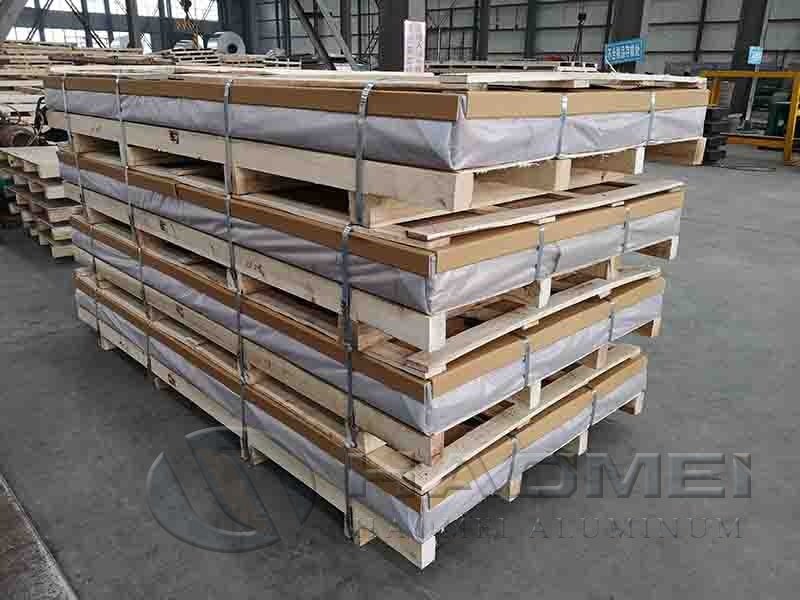
| Packaging | Require waterproof export packing, separators, edge protection, and bundle identification |
| Incoming inspection | Reserve the right to review certificates, dimensions, surface condition, and independent test results |
Receiving Inspection Steps
- Match plate markings and bundle labels with the certificate heat and plate identification.
- Measure thickness at multiple locations away from edges and compare results with the ordered tolerance standard.
- Inspect both faces for laminations, deep dents, transport damage, embedded contamination, and excessive oxidation.
- Check flatness on a stable inspection surface when cutting or automated welding requires controlled geometry.
- Quarantine material with missing traceability, incorrect temper, incomplete corrosion-test data, or inconsistent dimensions.
- Store plates indoors, dry, elevated from the floor, and separated to prevent trapped moisture and galvanic contamination.